
The rosary is one of the most recognized prayers in Catholic Christianity. According to Pew Research Center (2025), 22% of non-Hispanic white Catholics and 37% of Hispanic Catholics pray the rosary at least monthly — making it one of the most practiced Catholic devotions in the United States. If you're new to this devotion, or simply curious about it, this guide walks you through every step clearly and fairly.
This is a Catholic practice. If you come from a Protestant or non-denominational background, you'll find a balanced section below on how different Christian traditions view this prayer. The goal here isn't to push you toward any one tradition — it's to help you understand the rosary on its own terms.
Learn the basics of Christian prayer
Key Takeaways
- The rosary is a Catholic devotional prayer combining vocal prayers with meditation on 20 "mysteries" (scenes from the lives of Jesus and Mary).
- A standard rosary takes 15–20 minutes and uses a string of 59 beads to count prayers.
- The five main prayers are: the Apostles' Creed, the Our Father, the Hail Mary, the Glory Be, and the Fatima Prayer.
- Pope John Paul II added the five Luminous Mysteries in 2002, expanding the original 15 to 20 total.
- Many Catholics believe Mary intercedes for them before God — Protestants typically reject this, preferring direct prayer to Christ alone.
- You don't need a rosary bead string to start; you can count on your fingers or follow a guided audio rosary.
- If you want to explore prayer across traditions, Bible Expert's AI Bible Chat can help you find Scripture passages connected to each mystery.
What Is the Rosary?
The rosary is a structured Catholic prayer that combines repetitive vocal prayers with meditative reflection. Each prayer cycle centers on a "mystery" — a specific scene from the life of Jesus or Mary — which the person holds in mind while reciting the prayers aloud.
The word "rosary" comes from the Latin rosarium, meaning "rose garden" or "garland of roses." The Catholic Church has encouraged this devotion for centuries, and the Vatican's official description calls it "a compendium of the Gospel" — a way to walk through the life of Christ prayer by prayer. (Vatican, Rosarium Virginis Mariae, 2002.)
Citation Capsule — What Is the Rosary? The rosary is a Marian devotion structured around 20 Gospel mysteries. Pope John Paul II described it as "a Gospel prayer" centered on Christ, with Mary as a guide into his life rather than a substitute for direct access to God (Rosarium Virginis Mariae, §1, Vatican.va, 2002). Each decade (set of 10 Hail Marys) corresponds to one mystery and invites meditative focus on a scene from the Gospels.
What Are the Prayers Used in the Rosary?
Five core prayers make up the rosary. Here they are in the order you'll pray them, with their texts:
1. The Apostles' Creed
A brief summary of Christian faith, prayed once at the start:
"I believe in God, the Father Almighty, Creator of heaven and earth; and in Jesus Christ, His only Son, our Lord... I believe in the Holy Spirit, the holy Catholic Church, the communion of saints, the forgiveness of sins, the resurrection of the body, and life everlasting. Amen."
2. The Our Father (Lord's Prayer)
Prayed on each large bead (before each decade). Text: Matthew 6:9–13 (Catholic translation).
3. The Hail Mary
The most frequently repeated prayer — 10 times per decade, 50 times in a full rosary:
"Hail Mary, full of grace, the Lord is with thee. Blessed art thou among women, and blessed is the fruit of thy womb, Jesus. Holy Mary, Mother of God, pray for us sinners, now and at the hour of our death. Amen."
The first half comes directly from Luke 1:28 and Luke 1:42 (NIV). The second half — asking Mary to "pray for us" — is a Catholic addition based on the doctrine of the intercession of the saints.
4. The Glory Be (Doxology)
Prayed at the end of each decade:
"Glory be to the Father, and to the Son, and to the Holy Spirit; as it was in the beginning, is now, and ever shall be, world without end. Amen."
5. The Fatima Prayer
Added to Catholic practice after the reported 1917 Marian apparitions at Fatima, Portugal:
"O my Jesus, forgive us our sins, save us from the fires of hell, lead all souls to Heaven, especially those in most need of Thy mercy. Amen."
How Do You Hold and Use Rosary Beads?
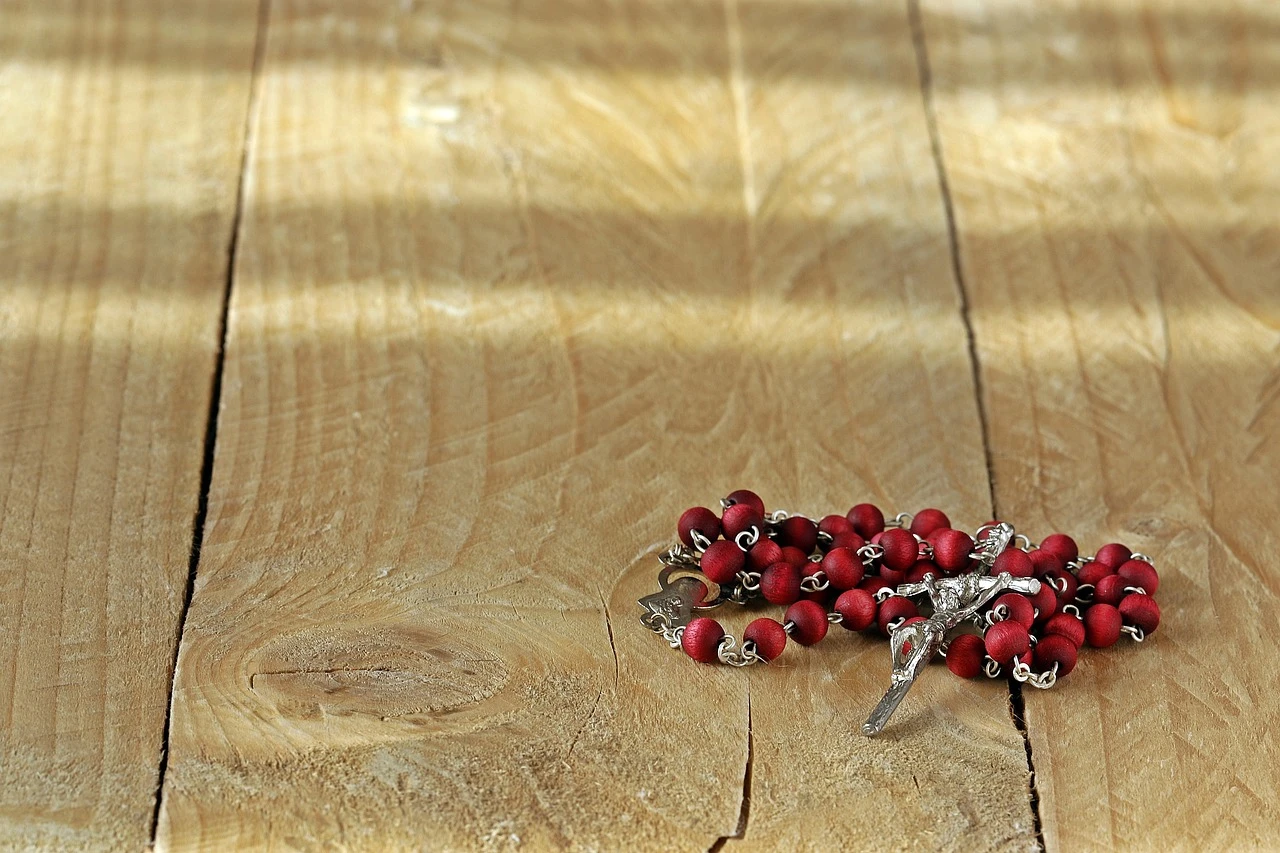
A standard rosary string has 59 beads arranged in a specific pattern. Here's what each section represents:
- 1 large bead — the Our Father bead at the top (connected to a short tail)
- 3 small beads — for three Hail Marys (for faith, hope, and charity)
- 1 large bead — another Our Father
- 5 groups of 10 small beads — each group is a "decade" for 10 Hail Marys
- 4 large beads — one between each decade (for the Our Father)
- A crucifix — attached to the tail, where you begin
You hold the crucifix and move bead by bead, finger to finger. The beads keep your place so you can focus on the mystery rather than the count.
Tip for beginners: You don't need a physical rosary to start. Count on your fingers, or use a free rosary app or guided audio. The beads are a tool, not a requirement.
Step-by-Step: How to Pray the Rosary
Here is the complete sequence for one full rosary — usually 15–20 minutes:
Step 1 — Make the Sign of the Cross and pray the Apostles' Creed
Hold the crucifix. Make the Sign of the Cross: touch your forehead, then your chest, then your left shoulder, then your right shoulder, saying "In the name of the Father, and of the Son, and of the Holy Spirit. Amen."
Then recite the Apostles' Creed in full while holding the crucifix.
Step 2 — Pray the Our Father on the first large bead
Move to the first large bead on the tail. Announce the first mystery (see list below), briefly call it to mind, then pray the Our Father.
Step 3 — Pray three Hail Marys on the three small beads
These three beads are traditionally offered for an increase in faith, hope, and charity. Say one Hail Mary per bead, then pray the Glory Be.
Step 4 — Pray each decade (five times)
Each decade follows the same pattern:
- Large bead — announce the mystery for that decade; pray the Our Father
- Ten small beads — pray one Hail Mary per bead while meditating on the mystery
- After the tenth bead — pray the Glory Be, then the Fatima Prayer
A "mystery" (a scene from the life of Jesus or Mary for meditation) is announced before each decade. You hold that scene in your imagination as you repeat the prayers — similar to lectio divina (a slow, meditative reading of Scripture).
Repeat this pattern for all five decades.
Step 5 — Conclude with the Hail Holy Queen and Sign of the Cross
After the fifth decade, pray the Hail Holy Queen (Salve Regina):
"Hail, Holy Queen, Mother of Mercy, our life, our sweetness and our hope! To thee do we cry, poor banished children of Eve; to thee do we send up our sighs, mourning and weeping in this valley of tears. Turn, then, most gracious Advocate, thine eyes of mercy towards us; and after this our exile, show unto us the blessed fruit of thy womb, Jesus. O clement, O loving, O sweet Virgin Mary!"
End with the Sign of the Cross and, optionally, a brief prayer for the Pope's intentions.
What Are the 20 Mysteries of the Rosary?
The mysteries are the core of the rosary — each one is a scene from Scripture or early tradition for your meditation. Pope John Paul II added the five Luminous Mysteries in his 2002 apostolic letter Rosarium Virginis Mariae, expanding the original 15 to 20 total.
The recommended schedule: Joyful on Mondays and Saturdays; Sorrowful on Tuesdays and Fridays; Glorious on Wednesdays and Sundays; Luminous on Thursdays.
The Five Joyful Mysteries (Monday, Saturday)
| Mystery | Scripture Reference |
|---|---|
| 1. The Annunciation | Luke 1:26–38 |
| 2. The Visitation | Luke 1:39–56 |
| 3. The Nativity of Jesus | Luke 2:1–20 |
| 4. The Presentation in the Temple | Luke 2:22–38 |
| 5. The Finding of Jesus in the Temple | Luke 2:41–52 |
The Five Luminous Mysteries (Thursday) — Added 2002
| Mystery | Scripture Reference |
|---|---|
| 1. The Baptism of Jesus | Matthew 3:13–17 |
| 2. The Wedding at Cana | John 2:1–12 |
| 3. The Proclamation of the Kingdom | Mark 1:14–15 |
| 4. The Transfiguration | Matthew 17:1–9 |
| 5. The Institution of the Eucharist | Luke 22:14–20 |
The Five Sorrowful Mysteries (Tuesday, Friday)
| Mystery | Scripture Reference |
|---|---|
| 1. The Agony in the Garden | Luke 22:39–46 |
| 2. The Scourging at the Pillar | John 19:1 |
| 3. The Crowning with Thorns | Matthew 27:27–31 |
| 4. The Carrying of the Cross | Luke 23:26–32 |
| 5. The Crucifixion | John 19:17–30 |
The Five Glorious Mysteries (Wednesday, Sunday)
| Mystery | Scripture Reference |
|---|---|
| 1. The Resurrection | Matthew 28:1–10 |
| 2. The Ascension | Luke 24:50–53 |
| 3. The Descent of the Holy Spirit | Acts 2:1–13 |
| 4. The Assumption of Mary | (early tradition; cf. Revelation 12:1) |
| 5. The Coronation of Mary | (early tradition; cf. Revelation 12:1) |
Note: The Assumption and Coronation of Mary are Catholic doctrines based on early Church tradition rather than a direct Gospel narrative. They are not accepted in Protestant theology.
Citation Capsule — The 20 Mysteries Pope John Paul II introduced the five Luminous Mysteries ("Mysteries of Light") in Rosarium Virginis Mariae (October 2002, Vatican.va) to fill a "gap" in the original rosary's coverage of Christ's public ministry — the years between the Nativity and the Passion. This brought the total from 15 to 20 mysteries, all anchored in New Testament events except the Assumption and Coronation, which rest on apostolic tradition.
What Does the Catholic Church Officially Teach About the Rosary?
The Catholic Church has a long and formal teaching on the rosary. Several popes issued major documents specifically on it:
- Pope Leo XIII wrote twelve encyclicals on the rosary between 1883 and 1898 — more than any pope before or since.
- Pope Paul VI reaffirmed it in Marialis Cultus (1974) as a "Gospel-centered" prayer.
- Pope John Paul II added the Luminous Mysteries in 2002 and called the rosary his "favorite prayer."
- The Catechism of the Catholic Church (§2708) describes it as a form of meditative prayer (meditation) rooted in the Gospel.
The Church is clear on one key point: Mary does not save — Christ does. The rosary asks Mary to intercede, the way you might ask a friend to pray for you. The USCCB and Catholic teaching consistently present Marian prayer as intercession — asking Mary to pray on your behalf — rather than worshipping her directly. The distinction matters: Catholics pray to Mary asking her prayers, not through her as a substitute for God.
Citation Capsule — Official Catholic Teaching The Catechism of the Catholic Church classifies the rosary under meditative prayer and defines it as a "Gospel prayer" (§2708, Vatican.va). The Church explicitly rejects the idea that Mary is co-equal with Christ. Rosarium Virginis Mariae §1 states: "The rosary, though clearly Marian in character, is at heart a Christocentric prayer." Mary leads the believer to Christ, not away from him.
Explore morning prayer routines
What Do Protestants and Evangelicals Think About the Rosary?
This is an honest disagreement between traditions, and it's worth presenting fairly. In our editorial work engaging readers across traditions, we find these concerns come up consistently — and Catholic responses to them are often unknown outside Catholic circles.
Most Protestant and Evangelical Christians do not pray the rosary. Their main theological objections are:
1. Prayers directed to Mary Many Protestants hold that prayer should be addressed to God alone — Father, Son, and Holy Spirit. Directing petitions to Mary, even as intercession, strikes them as unbiblical. They cite 1 Timothy 2:5 (NIV): "For there is one God and one mediator between God and mankind, the man Christ Jesus."
2. Repetitive prayer Some cite Matthew 6:7 (NIV) — "when you pray, do not keep on babbling like pagans" — as a caution against repetitive formulas. Catholic theologians respond that Jesus himself prayed the same prayer three times in Gethsemane (Matthew 26:44), and that the rosary's repetition is meant to clear the mind for meditation, not replace genuine prayer.
3. The Marian doctrines in the Glorious Mysteries The Assumption and Coronation of Mary are not found in Protestant or Orthodox canons as defined doctrines. Most Protestant denominations reject them.
Orthodox Christian view: Eastern Orthodox Christians have their own Marian prayer traditions (including the Theotokos devotion and the Jesus Prayer rope, called a chotki) but do not use the Latin rosary. They venerate Mary as "Theotokos" (God-bearer) and honor her highly — though in a different theological framework.
Evangelical scholars like Timothy George have noted that the rosary's Gospel-focus — walking through the life of Christ — is something Protestants can appreciate even if they disagree with the Marian theology embedded in it.
If you're navigating these differences and want to see what Scripture says on any of the contested passages, Bible Expert's AI Bible Chat can pull up the relevant texts in 1,200+ translations and let you compare them side by side.
Explore the ACTS prayer method used across Protestant traditions
How Long Has the Rosary Existed?
The rosary as we know it developed gradually across the medieval period. Here's a brief timeline:
- 12th–13th century: Repetitive recitation of 150 Hail Marys (mirroring the 150 Psalms) spread through monasteries. This was called the "Psalter of Mary."
- St. Dominic (1170–1221): A long-standing tradition links Dominic of Osma (founder of the Dominican Order) to the rosary's development. Historians note that the Dominic legend is largely devotional rather than verifiable — the formal attribution arose centuries after his death.
- 15th century: Dominican friar Alain de la Roche (c. 1428–1475) established confraternities to promote the prayer and helped standardize its form.
- 1569: Pope Pius V issued Consueverunt Romani Pontifices, formally establishing the rosary in its 15-mystery structure.
- 1883–1898: Pope Leo XIII's twelve rosary encyclicals marked the devotion's modern peak.
- 2002: Pope John Paul II added the Luminous Mysteries, creating the current 20-mystery structure.
Citation Capsule — History of the Rosary The Dominican link to the rosary's origin is historically contested. Anne Winston-Allen (Stories of the Rose, Penn State UP, 1997) traces the rosary's development to 15th-century Dominican confraternities rather than to St. Dominic himself. The devotion evolved from the monastic practice of reciting 150 Hail Marys as a "Psalter of Mary" — a practice documented from the 12th century onward.
Frequently Asked Questions
Q: Do you have to be Catholic to pray the rosary? The rosary is a specifically Catholic devotional prayer. Some Anglo-Catholics and high-church Anglicans also use it. Most Protestant traditions do not. If you're not Catholic, you can learn about it for understanding — but consider speaking with a pastor or priest if you're exploring whether it fits your faith practice.
Q: How long does one rosary take? A full five-decade rosary typically takes 15–20 minutes at a comfortable pace. Beginners sometimes take longer at first. Some people pray just one decade (about 3–4 minutes) as a starting point.
Q: Can you pray the rosary without the beads? Yes. The beads are a counting tool, not a sacramental requirement. You can count on your fingers, use a prayer app, or follow a guided audio rosary.
Q: What's the difference between a full rosary and one decade? A full rosary consists of five decades (50 Hail Marys total). One decade is a single set of 10 Hail Marys. Many Catholics pray one or two decades daily rather than a full rosary.
Q: Is the Hail Mary in the Bible? The first half of the Hail Mary is drawn directly from Scripture: "Hail, full of grace, the Lord is with you" (Luke 1:28 NIV) and "Blessed are you among women, and blessed is the child you will bear" (Luke 1:42 NIV). The second half — "Holy Mary, Mother of God, pray for us sinners" — is a later liturgical addition developed by the Church.
Q: Why do Catholics pray to Mary instead of directly to God? Catholics do not view this as "instead of" — they pray both to God and ask Mary (and other saints) to intercede. The theology is that asking Mary to pray for you is like asking a fellow believer to pray for you. Whether the saints in heaven can intercede is the point of theological dispute with Protestantism. If you want to study the passages on intercession, Bible Expert's side-by-side translation tool lets you compare 1 Timothy 2:1–5 across dozens of versions.
Q: When did the rosary become a Catholic practice? The rosary developed between the 12th and 15th centuries. Pope Pius V formally established its 15-mystery structure in 1569. Pope John Paul II added five Luminous Mysteries in 2002, creating the current 20-mystery format.
Q: What's the Fatima Prayer and where does it come from? The Fatima Prayer ("O my Jesus, forgive us our sins...") was reportedly given by an apparition of Mary to three shepherd children at Fatima, Portugal, in 1917. The Catholic Church approved the Fatima apparitions as "worthy of belief" in 1930. This prayer is not found in Scripture; it's part of the Fatima Marian devotion that the Church later incorporated into the standard rosary.
About the Author
Julien is the editorial voice of Bible Expert. She writes about prayer, Christian devotional practices, and Bible study tools for beginners and lifelong readers across all traditions. Bible Expert is a non-denominational app offering 1,200+ Bible translations, audio Bible, AI Bible Chat, and daily verses.
📱 Read the Bible anywhere with Bible Expert 1,200+ translations, audio Bible, and AI Bible Chat — free. iPhone / iPad · Mac · Android · Windows · Other device